by John Aldrich
Here is another pleasing storm pattern rug, this time by Emma Jean Willie. The colors here are somewhat unusual in that earth-tones aren't the most common in this style of rug. Since Emma is another older weaver, we again have a relatively simple, yet very pleasing design.
This rug measures 22" x 30" and is priced at $250. The catalog listing is 6927.
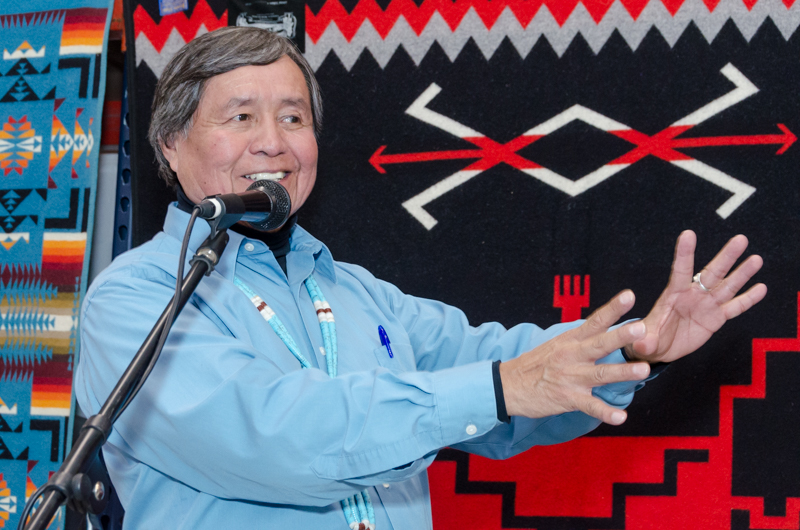
Emma Jean is one of our Leupp elders. She is usually seen in a supporting role as the wife of George Willie, one of the dwindling number of Navajo Code Talkers. George and Emma have been guests of honor at the rug show several times when George has been invited to take part in the Sunday morning Veterans Ceremony. Emma is always right there by his side helping with translation and other things.
But Emma Jean keeps busy herself, herding her sheep and weaving rugs.
See this 2010 post for more information about the rug catalog.
Notes: Every effort has been made to photograph and present the rugs with as accurate rendition of color as possible. It's not possible, however, to be certain that your computer won't show some variance. Where two prices are listed in the catalog, the higher represents what the weaver hopes to receive and the lower, the minimum she will accept. As has always been the case at ANE all the proceeds of every rug sale go entirely to the weaver. Prices are set by the weaver, and since there is no "middleman" they are typically very reasonable.
Sunday, February 19, 2012
Thursday, February 16, 2012
Fabric For The Elders
by John Aldrich
Traditional Navajos have a distinctive style of dress. For the women it includes tops made of panne velour fabric and long, full skirts made either of velour or cotton fabric. Part of the giveaway at each food run is fabric that the Elders can use to make these items.
Here is Rose Marie Clark at the Oljato food run wearing a skirt and top make from fabric provided by ANE. Although an Elder might be lucky enough to have a friend or family member with a sewing machine, most make their clothes themselves by hand.
Up until this year we obtained the material from Hancock Fabrics where employees worked together with ANE volunteers to cut the material. This year we ordered the material from a supplier, giving us a greater selection of colors at a lower price, and the bulk roles were delivered to the warehouse.
We had enough material to produce 977 three-yard pieces of panne velour and 500 four-yard pieces of cotton fabric. The challenge was figuring out an efficient way to cut all this into the required sizes. With the genius of Art Sleeper's engineering mind, a clever system was devised that allowed our volunteers to accomplish this task which took place over a period of a month.
This photo shows how spindles of metal pipe were inserted into the rolls and then suspended from our warehouse scaffolding.
The fabric is pulled out from the roll:
And then aligned to the pre-measured length:
It is then cut:
And folded:
While at the other end a different fabric pattern is being folded:
The final result of all this effort is enough fabric for the Elders to last through both the spring and fall food runs.
Traditional Navajos have a distinctive style of dress. For the women it includes tops made of panne velour fabric and long, full skirts made either of velour or cotton fabric. Part of the giveaway at each food run is fabric that the Elders can use to make these items.
Here is Rose Marie Clark at the Oljato food run wearing a skirt and top make from fabric provided by ANE. Although an Elder might be lucky enough to have a friend or family member with a sewing machine, most make their clothes themselves by hand.
Up until this year we obtained the material from Hancock Fabrics where employees worked together with ANE volunteers to cut the material. This year we ordered the material from a supplier, giving us a greater selection of colors at a lower price, and the bulk roles were delivered to the warehouse.
We had enough material to produce 977 three-yard pieces of panne velour and 500 four-yard pieces of cotton fabric. The challenge was figuring out an efficient way to cut all this into the required sizes. With the genius of Art Sleeper's engineering mind, a clever system was devised that allowed our volunteers to accomplish this task which took place over a period of a month.
This photo shows how spindles of metal pipe were inserted into the rolls and then suspended from our warehouse scaffolding.
The fabric is pulled out from the roll:
And then aligned to the pre-measured length:
It is then cut:
And folded:
While at the other end a different fabric pattern is being folded:
The final result of all this effort is enough fabric for the Elders to last through both the spring and fall food runs.
Sunday, February 12, 2012
Rug Of The Week - Storm by Madge Shephard
by John Aldrich
Storm pattern rugs are among the most popular for buyers to purchase. This week we feature one by Madge Shephard of Big Mountain. It measures 23" x 36" and is priced at $500. The catalog listing is 7028.
Storm pattern rugs can be very intricate with many design elements and color changes. Such elaborate weavings are more likely to be produced by younger weavers who have the eyesight and stamina to produce such rugs.
Our older weavers, like Madge, are more likely to create simpler designs with fewer colors. In such rugs, though, the basic elements of the design stand out more dramatically which gives them a different kind of appeal.
Madge is a well-known weaver in her late 80's who continues to weave every day. She still lives alone, although her daughter does reside nearby. Weaving is in her blood; it's part of her way of life and who she is. Madge, like many weavers, has supported herself and her family over the years through the output of her loom.
See this 2010 post for more information about the rug catalog.
Notes: Every effort has been made to photograph and present the rugs with as accurate rendition of color as possible. It's not possible, however, to be certain that your computer won't show some variance. Where two prices are listed in the catalog, the higher represents what the weaver hopes to receive and the lower, the minimum she will accept. As has always been the case at ANE all the proceeds of every rug sale go entirely to the weaver. Prices are set by the weaver, and since there is no "middleman" they are typically very reasonable.
Storm pattern rugs are among the most popular for buyers to purchase. This week we feature one by Madge Shephard of Big Mountain. It measures 23" x 36" and is priced at $500. The catalog listing is 7028.
Storm pattern rugs can be very intricate with many design elements and color changes. Such elaborate weavings are more likely to be produced by younger weavers who have the eyesight and stamina to produce such rugs.
Our older weavers, like Madge, are more likely to create simpler designs with fewer colors. In such rugs, though, the basic elements of the design stand out more dramatically which gives them a different kind of appeal.
Madge is a well-known weaver in her late 80's who continues to weave every day. She still lives alone, although her daughter does reside nearby. Weaving is in her blood; it's part of her way of life and who she is. Madge, like many weavers, has supported herself and her family over the years through the output of her loom.
See this 2010 post for more information about the rug catalog.
Notes: Every effort has been made to photograph and present the rugs with as accurate rendition of color as possible. It's not possible, however, to be certain that your computer won't show some variance. Where two prices are listed in the catalog, the higher represents what the weaver hopes to receive and the lower, the minimum she will accept. As has always been the case at ANE all the proceeds of every rug sale go entirely to the weaver. Prices are set by the weaver, and since there is no "middleman" they are typically very reasonable.
Sunday, February 5, 2012
Rug Of The Week - Crystal Star by Bah Yazzie Ashley
by John Aldrich
This week's rug is a beautiful creation in soft pastels by Bah Yazzie Ashley. She calls it Crystal Star.
The rug measures 18" x 23" and is priced at $300. It's beautifully woven by a master weaver. The catalog listing is 6786.
Bah is one of our Elders at Sanders and is quite a famous weaver. She has been wheelchair-bound for years, but this doesn't slow down her weaving.
At the Sanders food runs, Bah often makes a donation to the Program, such as the small rug she is holding in this photo:
Her weaving is usually done in the New Lands style and colors using yarns that are typically colored with vegetal dyes. Most of her weaving is sold through Bruce Burnham's trading post which is also the source of her yarn.
Bah Yazzie Ashley's rugs can sell for as much as $12,000.
See this 2010 post for more information about the rug catalog.
Notes: Every effort has been made to photograph and present the rugs with as accurate rendition of color as possible. It's not possible, however, to be certain that your computer won't show some variance. Where two prices are listed in the catalog, the higher represents what the weaver hopes to receive and the lower, the minimum she will accept. As has always been the case at ANE all the proceeds of every rug sale go entirely to the weaver. Prices are set by the weaver, and since there is no "middleman" they are typically very reasonable.
This week's rug is a beautiful creation in soft pastels by Bah Yazzie Ashley. She calls it Crystal Star.
The rug measures 18" x 23" and is priced at $300. It's beautifully woven by a master weaver. The catalog listing is 6786.
Bah is one of our Elders at Sanders and is quite a famous weaver. She has been wheelchair-bound for years, but this doesn't slow down her weaving.
At the Sanders food runs, Bah often makes a donation to the Program, such as the small rug she is holding in this photo:
Her weaving is usually done in the New Lands style and colors using yarns that are typically colored with vegetal dyes. Most of her weaving is sold through Bruce Burnham's trading post which is also the source of her yarn.
Bah Yazzie Ashley's rugs can sell for as much as $12,000.
See this 2010 post for more information about the rug catalog.
Notes: Every effort has been made to photograph and present the rugs with as accurate rendition of color as possible. It's not possible, however, to be certain that your computer won't show some variance. Where two prices are listed in the catalog, the higher represents what the weaver hopes to receive and the lower, the minimum she will accept. As has always been the case at ANE all the proceeds of every rug sale go entirely to the weaver. Prices are set by the weaver, and since there is no "middleman" they are typically very reasonable.
Tuesday, January 31, 2012
Winter Stories Night 2012
by John Aldrich
As we gathered for the annual Winter Stories night at the warehouse on Sunday, we were again invited to imagine that we were in a large hogan, part of a large Navajo family, gathered for a traditional winter evening of story telling and sharing about culture. Rodger Williams was once more the organizer and emcee of the event.
And once more the warehouse was full with an appreciative audience that included many Navajo families with their children. There was an extensive array of food that included fry bread and mutton stew for those who wanted to enjoy the full cultural experience.
Rodger led off with a welcome and a song and then introduced Steve Todechine who talked about Navajo culture, told a coyote story, and then had the audience participate in string games, a winter tradition.
Next, Eileen Quintana spoke about the tools, or "weapons", of a woman. Eileen truly speaks from the heart, and it's always inspiring to hear her message.
Here she explains about the brush, made of native plants, that can be used for personal care as well as housekeeping. Then she displayed weaving tools, very powerful implements, since the product of their use can provide for the most important necessities of life, food and shelter.
Many families on the reservation owe their survival to the weaver in the family who supports them through the sale of the rugs she weaves.
Eileen is coordinator for the Title VII program in the Nebo school district and brought with her a group of students who performed a Yupik dance.
Then our new Shi Yazhi princess, Emma Loughlin, introduced herself.
Emma has great poise and self-assurance. She will surely be a fine representative for ANE throughout the year.
Last year we were introduced to Emerson Bill and his group of singers. They were very popular with the audience, so we were delighted that they returned.
The combination of stirring drumming and amazing vocalizations was a special treat that left everyone wishing for more.
The last speaker was Julius Chavez who spoke of the importance of corn in Navajo culture. His remarks were particularly addressed to the Navajo children in the audience. Julius has been dismayed to find that many young Navajos don't know the difference between corn meal and corn pollen.
Both are very important but have different ceremonial uses. Corn meal is used in the blessing of homes while corn pollen is used in the blessing of people.
The different colors of corn each have their own significance.
White corn signifies the young boy while the yellow corn signifies the young girl. Corn, and its use, is central to Navajo culture and ceremonial life. Julius's explanation of its role was both informative and inspiring.
Julius also spoke about the warehouse where we were gathered. He views it as the heart of the program, the place from which the many blessings of ANE extend out to the Elders. He likened the center of the warehouse to the center of a corn field - the focal point from which these blessings emanate.
After another song from Emerson's group, we disbursed with a great sense of enrichment.
As we gathered for the annual Winter Stories night at the warehouse on Sunday, we were again invited to imagine that we were in a large hogan, part of a large Navajo family, gathered for a traditional winter evening of story telling and sharing about culture. Rodger Williams was once more the organizer and emcee of the event.
And once more the warehouse was full with an appreciative audience that included many Navajo families with their children. There was an extensive array of food that included fry bread and mutton stew for those who wanted to enjoy the full cultural experience.
Rodger led off with a welcome and a song and then introduced Steve Todechine who talked about Navajo culture, told a coyote story, and then had the audience participate in string games, a winter tradition.
Next, Eileen Quintana spoke about the tools, or "weapons", of a woman. Eileen truly speaks from the heart, and it's always inspiring to hear her message.
Here she explains about the brush, made of native plants, that can be used for personal care as well as housekeeping. Then she displayed weaving tools, very powerful implements, since the product of their use can provide for the most important necessities of life, food and shelter.
Many families on the reservation owe their survival to the weaver in the family who supports them through the sale of the rugs she weaves.
Eileen is coordinator for the Title VII program in the Nebo school district and brought with her a group of students who performed a Yupik dance.
Then our new Shi Yazhi princess, Emma Loughlin, introduced herself.
Emma has great poise and self-assurance. She will surely be a fine representative for ANE throughout the year.
Last year we were introduced to Emerson Bill and his group of singers. They were very popular with the audience, so we were delighted that they returned.
The combination of stirring drumming and amazing vocalizations was a special treat that left everyone wishing for more.
The last speaker was Julius Chavez who spoke of the importance of corn in Navajo culture. His remarks were particularly addressed to the Navajo children in the audience. Julius has been dismayed to find that many young Navajos don't know the difference between corn meal and corn pollen.
Both are very important but have different ceremonial uses. Corn meal is used in the blessing of homes while corn pollen is used in the blessing of people.
The different colors of corn each have their own significance.
White corn signifies the young boy while the yellow corn signifies the young girl. Corn, and its use, is central to Navajo culture and ceremonial life. Julius's explanation of its role was both informative and inspiring.
Julius also spoke about the warehouse where we were gathered. He views it as the heart of the program, the place from which the many blessings of ANE extend out to the Elders. He likened the center of the warehouse to the center of a corn field - the focal point from which these blessings emanate.
After another song from Emerson's group, we disbursed with a great sense of enrichment.
Sunday, January 29, 2012
Rug Of The Week - Mesa Birds by Mae Tso
by John Aldrich with the help of Judy Keane
This week's rug is a beautiful pictorial by Mae Tso entitled Mesa Birds. What is most striking to me is the color palette used in this weaving. The warmth of the hues evokes a strong feeling of the southwestern landscape which has a more literal rendering as well. The presence of birds and corn help bring life and hope to this evocation of one of the most beautiful areas on earth.
Mae wove this rug, and several similar ones, in the spring of last year as her husband Askie was terminally ill. Weaving these rugs, which also contain a variety of personal and family symbols, helped give Mae the strength to survive this challenging period in her life.
The rug is 28" x 47" and is priced at $2100. See the catalog listing, 6872, for more information or to order.
Mae is an Elder from Big Mountain which is the first area served by ANE food runs. In the 1980's There was great turbulence here because of the Hopi-Navajo land dispute which ultimately resulted in 10,000 Navajos being displaced from their traditional homelands. Many resisted these attempts to be relocated. Mae was one of those resistors and even spent time in jail for her efforts to remain on her homeland.
Here Mae is seen at the Big Mountain food run in May 2011. She is holding a similar, but somewhat smaller pictorial, 7004, which is also still in the catalog.
See this 2010 post for more information about the rug catalog.
Notes: Every effort has been made to photograph and present the rugs with as accurate rendition of color as possible. It's not possible, however, to be certain that your computer won't show some variance. Where two prices are listed in the catalog, the higher represents what the weaver hopes to receive and the lower, the minimum she will accept. As has always been the case at ANE all the proceeds of every rug sale go entirely to the weaver. Prices are set by the weaver, and since there is no "middleman" they are typically very reasonable.
This week's rug is a beautiful pictorial by Mae Tso entitled Mesa Birds. What is most striking to me is the color palette used in this weaving. The warmth of the hues evokes a strong feeling of the southwestern landscape which has a more literal rendering as well. The presence of birds and corn help bring life and hope to this evocation of one of the most beautiful areas on earth.
Mae wove this rug, and several similar ones, in the spring of last year as her husband Askie was terminally ill. Weaving these rugs, which also contain a variety of personal and family symbols, helped give Mae the strength to survive this challenging period in her life.
The rug is 28" x 47" and is priced at $2100. See the catalog listing, 6872, for more information or to order.
Mae is an Elder from Big Mountain which is the first area served by ANE food runs. In the 1980's There was great turbulence here because of the Hopi-Navajo land dispute which ultimately resulted in 10,000 Navajos being displaced from their traditional homelands. Many resisted these attempts to be relocated. Mae was one of those resistors and even spent time in jail for her efforts to remain on her homeland.
Here Mae is seen at the Big Mountain food run in May 2011. She is holding a similar, but somewhat smaller pictorial, 7004, which is also still in the catalog.
See this 2010 post for more information about the rug catalog.
Notes: Every effort has been made to photograph and present the rugs with as accurate rendition of color as possible. It's not possible, however, to be certain that your computer won't show some variance. Where two prices are listed in the catalog, the higher represents what the weaver hopes to receive and the lower, the minimum she will accept. As has always been the case at ANE all the proceeds of every rug sale go entirely to the weaver. Prices are set by the weaver, and since there is no "middleman" they are typically very reasonable.
What's Happening At ANE?
- January 29th Sunday: The Annual Winter Stories Night event, 5:00 p.m. at the warehouse.
- January 31st Tuesday: Volunteer Day at the warehouse, 9:30 a.m. to 12:30.
- February 3rd Friday: Volunteer Day at the warehouse, 9:30 a.m. to 12:30.
- February 7th Tuesday: Volunteer Day at the warehouse, 9:30 a.m. to 12:30
- February 10th Friday: Volunteer Day at the warehouse, 9:30 a.m. to 12:30.
- February 14th Tuesday: Volunteer Day at the warehouse, 9:30 a.m. to 12:30.
- February 17th Friday: No volunteer activities today.
- February 21st Tuesday: Volunteer Day at the warehouse, 9:30 a.m. to 12:30
- February 24th Friday: Volunteer Day at the warehouse, 9:30 a.m. to 12:30.
- February 28th Tuesday: Volunteer Day at the warehouse, 9:30 a.m. to 12:30.
- February 29th Wednesday: Rug Show volunteer meeting, 5:00 p.m. at the warehouse.
Subscribe to:
Posts (Atom)