by John Aldrich
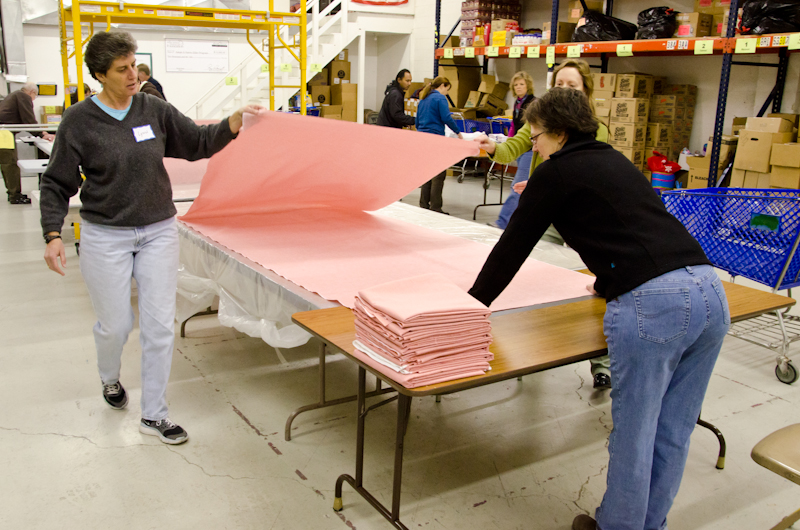
At the warehouse, the first few months of the year are devoted to preparing the giveaways that Elders will receive on the food runs as well as the gift boxes that sponsors can order. One of the biggest jobs for our warehouse volunteers is the preparation of the fabric that will be used for both giveaways and gift boxes. Two years ago we began to order and cut the fabric ourselves which has saved us considerable money but is labor intensive. This blog, written in 2012, describes the process that we devised to accomplish the task.
We are now in the midst of working on the fabric for the 2014 food runs, and the warehouse once again looks like the back room at Hancock's (except at Hancock's you probably wouldn't find guys doing this work).
Please refer back to the link above to see in greater detail how the cutting process works at our "shop".
We make an effort at the warehouse to make each giveaway something special for the Elder who will receive it. In the case of the fabric, this involves rolling it and tying it up with a ribbon. Robin Field-Williams is one of the volunteers working on this final touch.
This is the second week of our textile operation, so quite a bit of inventory has already been accumulated. It takes 12 to 15 volunteers to keep this assembly line running and 6 volunteer days or 3 weeks to finish the fabric project.
Here is some of the green panne fabric that will either end up as giveaways at the food runs or be put into Grandma boxes that can be ordered by sponsors.
Waiting for their turn at the cutting tables are these bolts of calico.
Here are some interesting facts and figures supplied by C.J. Robb who manages our warehouse operations:
We order a total of 6300 yards of fabric from a wholesaler. This costs around $20,000. Although this is a large sum, it represents a saving of about $9000 over what we paid prior to 2012 to order the fabric locally and have it cut for us.
The fabric order includes 2700 yards of heavy panne which is cut into 3 yard pieces, and 3600 yards of lighter calico which is cut into 4 yard pieces. These bundles will be split between giveaways and Grandma boxes. Grandma boxes contain, among other things, a bundle of panne and a bundle of calico, enough for an Elder to make a whole outfit - skirt and top. We will assemble 400 of these boxes which will be split between the spring and fall food runs.
500 bundles of panne and calico will be split between the spring and fall food runs and used as giveaways. These are among the most popular of the gifts that Elders receive and among the most mentioned when Linda receives thank-you letters.
It's clear that a lot of effort takes place behind the scenes to make these beautiful gifts for the Elders possible. We owe a huge amount of thanks to our warehouse volunteers, the unsung heroes of ANE.
What happens when all this material gets to the reservation?
Here is Mary Begay explaining to the Grandmas at Navajo Mountain that each will receive a Grandma box as a gift provided by a grant from American Express and that each box will contain a bundle of panne and one of calico.
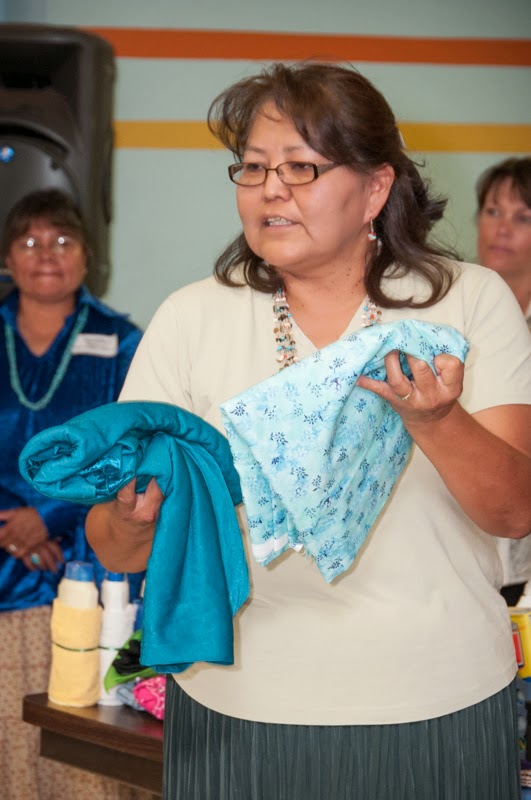
Rena Greyeyes holds the contents of her Grandma box including the fabric.
Here Linda helps an Elder at Leupp pick out a color.
And at Navajo Mountain, an Elder considers the choices among the bundles of calico.
The final outcome of all this effort from warehouse-to-foodrun-to-hogan is a completed outfit that might be worn at the next food run. Bessie Paul of Dilkon proudly wears hers.
Showing posts with label Giveaways - Fabric. Show all posts
Saturday, February 8, 2014
Thursday, February 16, 2012
Fabric For The Elders
by John Aldrich
Traditional Navajos have a distinctive style of dress. For the women it includes tops made of panne velour fabric and long, full skirts made either of velour or cotton fabric. Part of the giveaway at each food run is fabric that the Elders can use to make these items.
Here is Rose Marie Clark at the Oljato food run wearing a skirt and top make from fabric provided by ANE. Although an Elder might be lucky enough to have a friend or family member with a sewing machine, most make their clothes themselves by hand.
Up until this year we obtained the material from Hancock Fabrics where employees worked together with ANE volunteers to cut the material. This year we ordered the material from a supplier, giving us a greater selection of colors at a lower price, and the bulk roles were delivered to the warehouse.
We had enough material to produce 977 three-yard pieces of panne velour and 500 four-yard pieces of cotton fabric. The challenge was figuring out an efficient way to cut all this into the required sizes. With the genius of Art Sleeper's engineering mind, a clever system was devised that allowed our volunteers to accomplish this task which took place over a period of a month.
This photo shows how spindles of metal pipe were inserted into the rolls and then suspended from our warehouse scaffolding.
The fabric is pulled out from the roll:
And then aligned to the pre-measured length:
It is then cut:
And folded:
While at the other end a different fabric pattern is being folded:
The final result of all this effort is enough fabric for the Elders to last through both the spring and fall food runs.
Traditional Navajos have a distinctive style of dress. For the women it includes tops made of panne velour fabric and long, full skirts made either of velour or cotton fabric. Part of the giveaway at each food run is fabric that the Elders can use to make these items.
Here is Rose Marie Clark at the Oljato food run wearing a skirt and top make from fabric provided by ANE. Although an Elder might be lucky enough to have a friend or family member with a sewing machine, most make their clothes themselves by hand.
Up until this year we obtained the material from Hancock Fabrics where employees worked together with ANE volunteers to cut the material. This year we ordered the material from a supplier, giving us a greater selection of colors at a lower price, and the bulk roles were delivered to the warehouse.
We had enough material to produce 977 three-yard pieces of panne velour and 500 four-yard pieces of cotton fabric. The challenge was figuring out an efficient way to cut all this into the required sizes. With the genius of Art Sleeper's engineering mind, a clever system was devised that allowed our volunteers to accomplish this task which took place over a period of a month.
This photo shows how spindles of metal pipe were inserted into the rolls and then suspended from our warehouse scaffolding.
The fabric is pulled out from the roll:
And then aligned to the pre-measured length:
It is then cut:
And folded:
While at the other end a different fabric pattern is being folded:
The final result of all this effort is enough fabric for the Elders to last through both the spring and fall food runs.
Subscribe to:
Posts (Atom)