Showing posts with label Navajo Culture. Show all posts

Tuesday, January 31, 2012

Winter Stories Night 2012

by John Aldrich

As we gathered for the annual Winter Stories night at the warehouse on Sunday, we were again invited to imagine that we were in a large hogan, part of a large Navajo family, gathered for a traditional winter evening of story telling and sharing about culture. Rodger Williams was once more the organizer and emcee of the event.

And once more the warehouse was full with an appreciative audience that included many Navajo families with their children. There was an extensive array of food that included fry bread and mutton stew for those who wanted to enjoy the full cultural experience.

Rodger led off with a welcome and a song and then introduced Steve Todechine who talked about Navajo culture, told a coyote story, and then had the audience participate in string games, a winter tradition.


Next, Eileen Quintana spoke about the tools, or "weapons", of a woman. Eileen truly speaks from the heart, and it's always inspiring to hear her message.


Here she explains about the brush, made of native plants, that can be used for personal care as well as housekeeping. Then she displayed weaving tools, very powerful implements, since the product of their use can provide for the most important necessities of life, food and shelter.

Many families on the reservation owe their survival to the weaver in the family who supports them through the sale of the rugs she weaves.

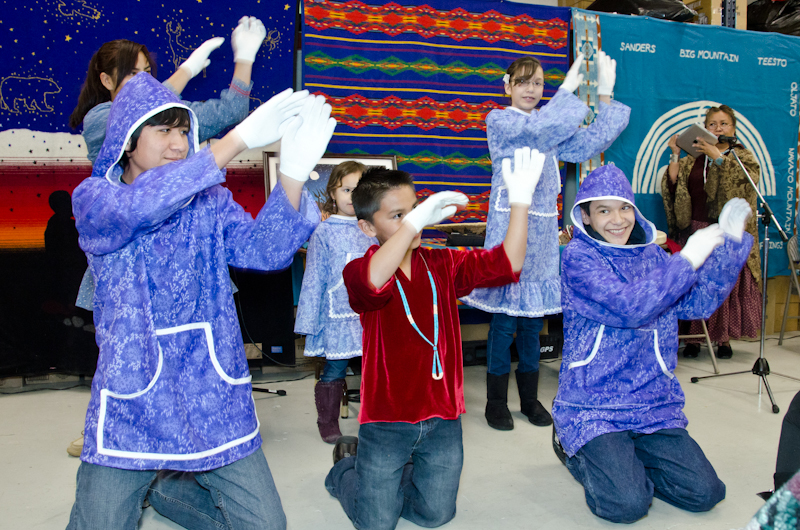
Eileen is coordinator for the Title VII program in the Nebo school district and brought with her a group of students who performed a Yupik dance.

Then our new Shi Yazhi princess, Emma Loughlin, introduced herself.

Emma has great poise and self-assurance. She will surely be a fine representative for ANE throughout the year.

Last year we were introduced to Emerson Bill and his group of singers. They were very popular with the audience, so we were delighted that they returned.

The combination of stirring drumming and amazing vocalizations was a special treat that left everyone wishing for more.

The last speaker was Julius Chavez who spoke of the importance of corn in Navajo culture. His remarks were particularly addressed to the Navajo children in the audience. Julius has been dismayed to find that many young Navajos don't know the difference between corn meal and corn pollen.

Both are very important but have different ceremonial uses. Corn meal is used in the blessing of homes while corn pollen is used in the blessing of people.

The different colors of corn each have their own significance.

White corn signifies the young boy while the yellow corn signifies the young girl. Corn, and its use, is central to Navajo culture and ceremonial life. Julius's explanation of its role was both informative and inspiring.

Julius also spoke about the warehouse where we were gathered. He views it as the heart of the program, the place from which the many blessings of ANE extend out to the Elders. He likened the center of the warehouse to the center of a corn field - the focal point from which these blessings emanate.

After another song from Emerson's group, we disbursed with a great sense of enrichment.

Wednesday, December 14, 2011

Rug Show Moments 2011 - Fine Dress

by John Aldrich

The rug show is a feast for the eyes. The displays of rugs, jewelry, baskets, and crafts certainly create an extravagant visual treat. But add to that the traditional dress of the Elders and their families and you have something extraordinary.

Although I'm only guessing, I doubt that Navajos living their daily lives on the reservation have too many occasions to bring out their finery. But the rug show is one event where they show their best.

This photo of the Blackhorse-Benale family of Forest Lake shows multiple generations all dressed in the traditional manner:

Brightly colored velveteen blouses and skirts augmented by silver and turquoise jewelry make a dazzling display of color. Turquoise is the favored stone for jewelry as it traditionally provides protection to the wearer.

Here are Frances Bahe and her daughter Marie wearing their beautiful jewelry:

Frances is also wearing a Pendelton coat, another favorite among traditional Navajos.

Most traditional Navajos do not cut their hair, but wear it done up tightly and tied with yarn in a hair bun. This style is not limited to the women as Julius Chavez demonstrates:

Another aspect of traditional dress is leather moccasins complemented by deer hide leggings. Here Darlene Furcap is fitting the leggings for her daughter:

Young Navajo women often wear rug dresses at special occasions. These are woven in the same manner as blankets. At the show this year were two very special rug dresses. The first was created for Marty Whitehair by her parents for her graduation. It incorporates a horse in keeping with a theme often seen in the weavings of this family:

The other unique dress is a multiple rug design made by Darlene Furcap for her daughter Dianna:

And finally, back to the topic of hair, Harry Begay shows that he has talents beyond roping as he fixes the hair of his niece, Bobbi Jo Whitehair:

Sunday, May 23, 2010

Sunrise Ceremony - Canyon de Chelly

by Charles Keen

(Note: Charles is a volunteer from Chelmsford, MA who attended his first food run in 2008. He has returned annually since. His initial reference is to an optional sunrise ceremony which is held in conjunction with each food run.)

Sitting on the cold rocks overlooking the depths of Canyon de Chelly in the white light awaiting the arrival of the first yellow rays of the sun Linda Myers posed two existential questions:  “Who Am I?” and “Why Am I here?”.  The questions are embedded in the cosmology of Navajo creation stories of the Hero Twins, but of course they apply to each of the 40+ members of our circle.  We are asked to attempt answers.  We struggle with these lifelong imponderables as did the twins in her story; one spent much time seeking wisdom among buffalo and bear elders and was rewarded with deep insights while the other tried a short cut following the trickster coyote and finally recognized his failure.  The questions continue to resonate.

Who Am I?  I grew up on an Iowa farm with five younger brothers; we fed cattle and raised corn .  Dad was a self-taught agricultural economist; business and markets were discussed at every meal.  Mother was a teacher with a deep sense of education, history, and genealogy.  She insured that we all knew that we were 14th generation from the Mayflower; I later learned that Dad’s paternal ancestors only arrived in the 18th century from Sweden.  Both parents insured that all of us had extensive higher education and saw ourselves establishing careers off the farm. We did but with an imbedded sense of the Land.

Age and experience has burnished some of the sharp edges of youth.  Marriage, two fine daughters, years in Canada, travel, challenging work building and deploying Internet precursor technology in many countries, and death  have been part of my life’s journey.  I have sought experience and understanding.  I enjoy getting past national politics and propaganda to discover the common elements of family, work, and culture in our individual everyday lives.

Why Am I here?  Over the years I have gained a sense of place in several countries and in the American Midwest, Northeast, East, and Pacific Coast.  However my sense of the history, culture, and place of the Southwest United States had been shaped only by Westerns and 30+ thousand foot airplane window views.  I had some sense of the sorry and sordid history of the treatment of American Indians but with details only from the East.

Exposure to the Adopt-A-Native-Elder organization and the opportunity to go on food runs – I have now done four – has given me a ground level sense of place and the lives the Navajo live.  It is a close-up view of agriculture, commerce, health care, diet, housing, culture, history, and intergenerational family life I could never gotten from books.  Visiting the Navajo Nation Museum and Zoo at Window Rock gives a sense of the Navajo view of themselves.  Stopping at the Hubble trading post at Ganado provides the context for the sources of the colorful rug weaving art practiced today.  Spending time with experienced ANE volunteers has given me a sense of the deep respect they share for the Navajo culture and elders they support. 

Navajo history now has a distinct shape.  One cannot look down into the Canyon de Chelly and not see its walls as the site of their 1862 US military roundup and forced Long Walk to a New Mexico multi-year imprisonment; many died.   One then remembers depression era Bureau of Indian Affairs enforced culling of sheep herds and the recent Peabody Coal engineered police enforced family resettlements to clear title and access to rich Indian coal.

ANE food runs provide countless small insights into Navajo life.  Diet and medical problems are apparent. Loose sheep, cattle, and horses grazing on street and highways reflect both limited rainfall and an early New England sense of town common grazing lands.  (I always shudder at the sight thinking of many youthful, dangerous episodes chasing our escaped farm cattle off the busy US Highway 30.) The sense of common lands is reinforced as homesteads seem plopped in random clusters without separating fences or individual driveways.

 Flashes of humor and financial need are apparent during giveaway activities and in the types of supplemental medical supplies some elders receive.  The numbers of grandchildren who bring elders to food run sites reflect parents working off the reservation.  Noting whether elders speak Navajo or English to the grandchildren gives a hint of the durability of the culture.  Carrying supplies into an elder’s trailer, hogan, or house gives an intimate sense of both income and living arrangements. 

Details aside, the overwhelming sense one gets from elder faces, smiles, gentle handshakes, or a thank you given in broken English or Navajo is of genuine gratitude.  We volunteers are privileged to support a proud people who have lived hard lives with little income in a harsh land that they cherish deeply.   We are welcomed as caring outsiders who truly want to help.  Food runs, of necessity, are well organized; the pace is hectic and the physical conditions sometimes brutal.  Still, I feel privileged to be part of the ANE process; it has given me a sense of a special place and a people whose rural sheep herding traditions are under immense economic and cultural pressures for change from the larger American society.  I treasure the time spent on the food runs with these unique People.

Sunday, January 24, 2010

Weaving World Peace - Rug Show Theme For 2010

by John Aldrich

Each rug show has its own theme, and each theme embodies the spirit of that show. For this years show, to be held November 12-14, the theme is Weaving World Peace.

The idea for this theme arose during the 2009 show. During recent rug shows an event has been held on Saturday afternoons called the Native American Idol Contest which is based loosely on the American Idol model. The Elders love to sing, and the idea here was to present them with a theme and let them improvise a song after being given a few minutes to prepare. In this case the theme was  What I Want Santa to Bring Me For Christmas.

Elsie Benale, a fine weaver from Forest Lake, sang about her wish for  World Peace. This started Linda thinking that this might be a good theme for the next rug show, and she presented the idea to all the Elders the following day. It was well-received, and the weavers were encouraged to create rugs based on this theme. Smaller rugs would be submitted to be used for rug show advertising and promotion and larger rugs could be presented later to be sold at the show.

World Peace seems like a very lofty goal for our organization, but it fits very well with the Program mission as well as with the tenets of Navajo culture and philosophy. The Adopt-A-Native-Elder Program is truly an international organization. We have supporters and donors from around the world and sponsors living in Australia, New Zealand, and Germany. A volunteer has come to the rug show from Holland for the past two years.

Rodger Williams points out that traditional Navajo prayers end with the phrase Hozhó Nahasdlii' being repeated four times. This is a plea for restoration of harmony and balance which can be interpreted at a personal level or at a more general level for the larger good.

Rodger relates that if you ask Navajos what World Peace means to them, you will find that they respond to you from a spiritual perspective. To the Diné (Navajo) peace is synonymous with the word K'é. This is a Navajo word which means relations and relatives or it could mean a peaceful state among all living beings. Thus we are reminded that we are all connected to one another through the Brotherhood of Man.


Here is a drawing created by Rodger as an illustration of this year's theme. Superimposed on an image of the world are elements contained in the Program logo. Hands from different cultures are seen coming together under a rainbow and sacred eagle feather. Differences are mended. World Peace is fostered.


Saturday, January 9, 2010

Winter Stories Event At The Warehouse

In the previous blog Rodger Williams describes the significance of story telling in Navajo culture. It turns out that you won't need to travel to the reservation to experience this aspect of Navajo life. For the past few years Rodger has organized an event at the ANE warehouse which highlights story telling, singing, and other facets of Diné culture. It has become an increasingly popular event and is open to everyone.

This year's event will take place on Sunday evening, January 31st, at 5:00 p.m. The warehouse is located at 328 W. Gregson Ave. in Salt Lake City. This map will help pinpoint the location if you need directions.


Rodger is the organizer and emcee of the event.

 
Last year Julius Chavez demonstrated the sacred art of sandpainting  to a rapt audience.


Lacee Harris tells stories of ma'ii (coyote).

 
Eileen Quintana speaks of what Navajo culture means to her.

 
A group of Eileen's students performs songs. Eileen works with children in the Nebo school district to raise their awareness of their cultural background.

Friday, January 8, 2010

Winter Stories

by Rodger Williams

Storytelling is a favorite pastime among Navajos, and this activity takes place primarily during the winter months. Our stories have lessons in them as well as entertainment. They say it is the stories that keep us, take care of us, and it's the stories that will live as long as our people live. There are certain people among us who keep the stories for us, and we can go to them if we have a need to gain insight or if we need a blessing. These stories are like a mirror for us and also tell our history.

When some of the animals go to rest or hibernate for the winter months, then we can talk about them because they cannot hear us. But the coyote - - - we can talk about him anytime; he never goes anywhere and is always here; he never leaves us, and we can never get rid of him. We are told that Coyote Is Us! All our trickery, all our double-talk, all our mischievousness, and even our playfulness, reflect back to us through Coyote. In fact, our winter stories are all about the adventures of Coyote and all the other animals with whom he interacts.

The reptiles will go underground along with the ants and prairie dogs as well as many others who will be living in the "other world" for a time. They teach us about how to go within our deeper selves to seek deeper things in life. They teach us that this  world where they go exists along with ours and that we can travel there and back if we so desire.

The bear, for instance, represents the West cardinal direction or the place of the spiritual realms. The bear, the protector symbolically, is a powerful creature who does not back down from anyone.  You do not want to get between the mother bear and her cubs. Like him or her, when we go within ourselves to the space where our reservoir of spirit and the will to go on are located, we seek greater power and gain our strength. If we learn to use it we will then have the power of both worlds.

We can talk about the bear (while he is away), and he will not do anything to us from this "distance". They say when you are talking about the bear you might will him to come to you, which is not a good thing. We cannot abuse the spiritual energy of the bear. He or she is too powerful for the people. There are "things" that we are told to leave alone for our own good. It is like the west is a place to go "down" like the sun, and the east is a place for rising or returning. We can tell our stories about any of the creatures that are in that place of resting. It is out of respect for them that we do not mention them in our stories and in our trivial conversations at other times. These animals will be "asleep" until after the first thunder in the springtime.